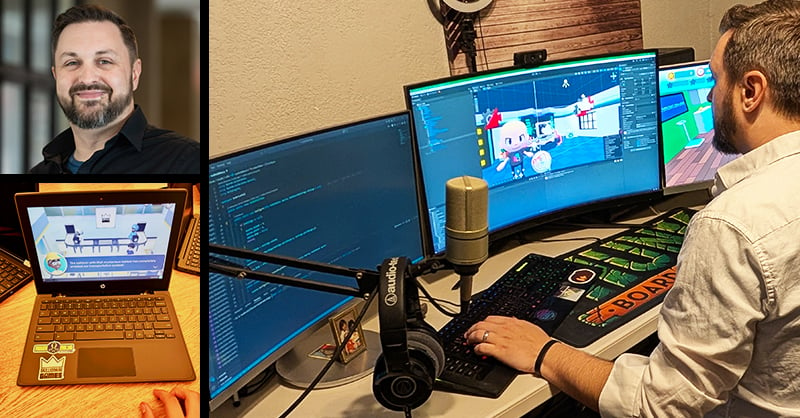
By Dustin Hendrickson
VP of Engineering, Skillionaire Games
Most people can describe a job long before they can do it.
They can list the tools. Articulate the steps. Narrate the training videos. On paper, they are ready.
Then they touch the work. And things change in a hurry.
Ideas and concepts aren't yet fleshed out and put into action. It's only when ideas move into the field that we are able to enter the world of constraint, choice, and consequences. Conceptual learning can create a false sense of familiarity with a field. But operational competence outside of the classroom and in the field requires judgment under constraint. Those are not the same thing.
At Skillionaire Games, we faced a choice early on in concepting our career games development.
We could abstract reality into the concepts that are light, fast, and easier (and cheaper!) to build.
Or we could simulate the work itself.
We chose to simulate it.
That decision has shaped everything about how we build our games.
Concepts Don't Build Skills; Friction Does
In game development abstraction is the default for good reasons.
It shortens development cycles. It lowers technical risk. The simplicity allows it to perform better across devices. It is easier to make accessible. It is simpler to maintain.
This is not a critique of abstraction. It is rational. It is efficient. It is often the right business decision.
Abstraction wins because it is cheaper and safer.
But abstraction has a hidden cost when your goal is skill transfer.
Conceptual training does not enforce consequences. Real work does.
On a real job site, tools have weight, sequence, and limits. Materials run out. Steps must happen in order. Physical space constrains movement.
In any industry or career, the work in the field produces friction. In skills development, you cannot skip friction.
Friction shapes decisions.
When you remove friction, you do not just remove difficulty. You remove the need for judgment. And when judgment is not exercised, it does not develop.
Immersion is not about photorealism.
It is about consequences.
Real Work Is Built On Constraints; Work Simulations Are Too
Simulating work within a game is expensive in ways that are not obvious until you build it.
Consider a tool like a handheld laser welder within a gameplay environment. It is not simply a button to press. In the real world, tools are rarely just “on” or “off.” Their effectiveness depends on context—what has already been done, what materials are present, and what conditions exist. This is why simulation matters.
A tool may be used correctly, incorrectly, or in a way that is only partially effective. Sometimes it cannot be used at all until a prior step is completed. One action can invalidate another, and dependencies quickly emerge.
Environments, too, introduce their own complexity. Space matters. Order matters. Physical access matters.
If a component is obstructed, the system needs to know. If a player installs something out of sequence, the world within the game must respond consistently, just as real life does.
Constraints add another layer. Time pressure changes behavior. Resource limits force prioritization. Failure states must matter or they become noise.
And when failure matters, recovery flows, the steps the game includes to restore order, must be designed just as carefully as success paths.
Complexity compounds. It does not stack neatly or linearly.
Every system interacts with another system. Performance budgets get stressed. Edge cases, scenarios that occur outside of normal frameworks, multiply.
Testing within games becomes about human behavior under varied conditions, not just feature verification.
Every Shortcut Teaches Something
Whether within gaming development or other fields of work, these are tradeoffs leaders do not always acknowledge openly.
Realism stresses our rendering and simulation budgets. Accessibility can conflict with physical accuracy. Simplifying a system to make it easier can unintentionally teach the wrong habit.
In all of life, every shortcut encodes a value judgment.
It says this constraint matters and that one does not.
That is not just an engineering decision. It is a leadership decision. At Skillionaire Games, we chose the harder path because we believe skills require friction.
Confidence does not come from exposure. It comes from repetition under constraint and even stress.
If the experience is easier than the job, it does not prepare people for the job. It misleads them.
Respecting learners means respecting the work itself first.
If the real world demands sequencing, tradeoffs, and consequences, our simulations should too.
Obviously This Is Bigger Than Games
It applies to onboarding, workforce training, and any system where you expect performance under pressure.
Leaders have to decide what they are willing to fake, where they will allow shortcuts, and when they will soften friction.
But difficulty is not the enemy.
Misalignment is.
Simulating work is expensive.
Not simulating it is more expensive later.
______
Making Work Games Work is an ongoing series about designing and engineering games that sit at the intersection of entertainment, education, and workforce development. Written from a technical perspective shaped by experience across some of the largest edtech platforms and major video game studios, the series examines the tradeoffs involved in translating real work into interactive systems that are engaging, accurate, and accessible while expanding career awareness for under-resourced youth and helping employers build stronger workforce pipelines.
Powered by skillsgapp.